
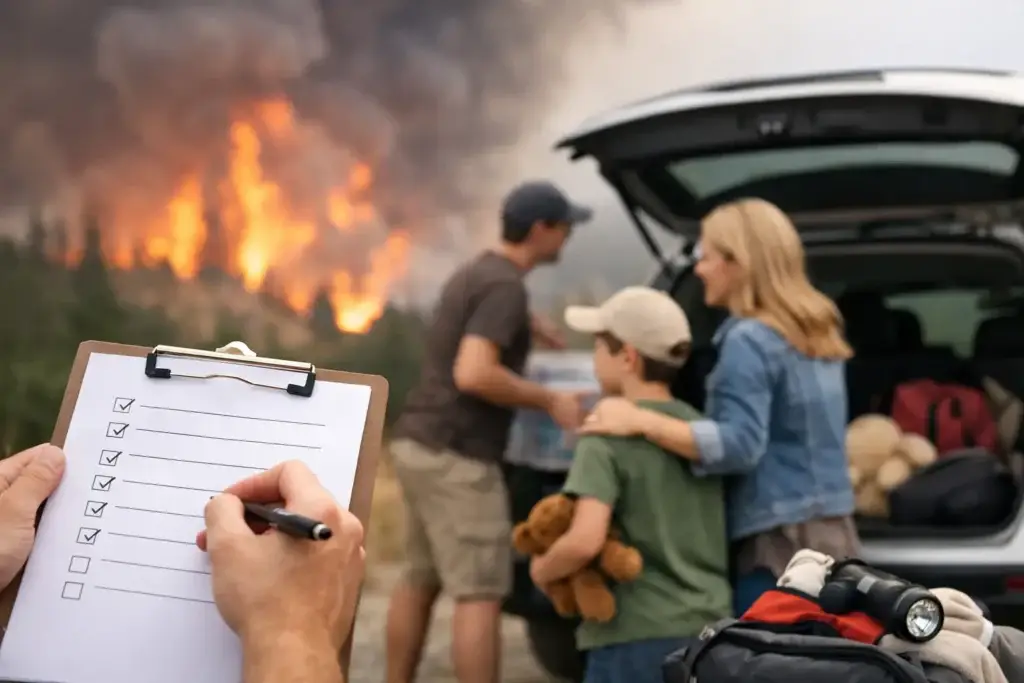
A wildfire evacuation checklist for families is not something to print after smoke reaches your street. By then, roads may be blocked, cell service may be strained, children may be frightened, and every missing item becomes a delay. Build your plan while the sky is clear, then make leaving a simple sequence your household can follow without debate.
Wildfires can shift direction fast. An evacuation warning can become an order with little notice, especially during high winds. Your job is not to predict the fire. Your job is to make sure your family can leave safely when officials tell you to go.
Build a wildfire evacuation checklist for families before fire season
Start with the people who depend on you. Every household needs one designated decision-maker, but everyone old enough to understand should know what happens when an alert arrives: shoes on, go-bag in hand, pets loaded, vehicle moving. Assign age-appropriate jobs now so nobody is searching for instructions during an evacuation.
Keep your master checklist on paper in a visible place and save a copy on each adult’s phone. Do not rely on memory or a single charging cable. Smoke, stress, and interrupted power make ordinary tasks harder.
Your family plan should answer four questions: Where will we go? Which two routes can we use? How will we communicate if separated? What must leave with us because it cannot be replaced?
Choose an out-of-area contact who can relay messages if local networks are overloaded. Pick a meeting place outside your immediate neighborhood and a second location outside the evacuation zone. If you have school-age children, confirm the school’s wildfire release and reunification procedures before an emergency.
Pack one go-bag per person
A shared bin is useful, but each person needs a bag they can grab. Use a backpack or durable duffel that is light enough to carry. Store it near an exit, not in a garage buried behind seasonal gear.
Each go-bag should hold:
- Three days of drinking water and shelf-stable food that does not require cooking
- A change of clothes, sturdy closed-toe shoes, socks, a warm layer, and rain protection
- Prescription medication, copies of prescriptions, glasses, and essential medical supplies
- A first-aid kit, flashlight or headlamp, extra batteries, whistle, and multi-tool
- N95 masks sized for adults and children who can safely wear them, plus protective goggles
- Phone charging cables, a power bank, cash in small bills, and a paper map
- Personal hygiene supplies, including wipes, toilet paper, menstrual products, and hand sanitizer
- Comfort items for children, such as a small book, stuffed animal, headphones, or familiar snack
For infants, add formula, bottles, diapers, wipes, and any feeding or medical equipment. For older adults, account for mobility aids, hearing-aid batteries, continence supplies, and a current medication list. A kit that works for a healthy adult may fail the person who needs it most.
Protect documents and irreplaceable records
Put identification, insurance information, home inventory records, medical documents, vehicle titles, and financial account details in a waterproof, fire-resistant document bag. Keep digital copies on a secure device or encrypted cloud account, but take paper copies too. You may need them when internet access is limited or when filing claims away from home.
Photograph every room, major appliance, valuable item, and the exterior of your property before fire season. Update the photos after large purchases or renovations. This takes less than an hour and can save days of confusion after a loss.
Prepare the vehicle that gets your family out
A vehicle is part of your evacuation equipment. Do not wait until a red-flag warning to discover a low tire, empty tank, or dead battery.
Keep at least a half tank of fuel during wildfire season. If an evacuation warning is issued, fill up immediately if it is safe to do so. Gas stations can lose power, run dry, or become inaccessible when everyone leaves at once. Electric vehicle owners should maintain a meaningful charge buffer and know charging options beyond their neighborhood.
Keep a vehicle kit with water, blankets, a flashlight, phone chargers, a paper map, jumper cables, basic tools, and a small first-aid kit. A portable power station can support phones and critical small devices during an extended outage, but it is not a substitute for leaving early. Never remain in a danger zone simply because you have backup power.
Load the vehicle in a fixed order: people, pets, medications, documents, go-bags, then pre-selected valuables if time permits. This prevents a common mistake: filling the car with possessions while someone forgets essential medication or a child’s car seat.
Make a plan for pets and animals
Pets are family, and evacuation shelters do not always accept them. Identify pet-friendly lodging, boarding options, and friends outside your area before fire season. Keep carrier-ready pets accustomed to their carriers rather than trying to force them inside during a crisis.
Prepare a pet kit with several days of food and water, bowls, medications, vaccination records, a leash, waste bags, a carrier, and a current photo of each animal. Put identification tags on pets and confirm that microchip contact information is current.
If you have livestock, the timeline is even tighter. Arrange trailers, destination space, and loading help well before a warning. Large-animal evacuation is not a last-minute task.
Know what to do at each alert level
Wildfire alerts are not all the same. Local terminology can vary, but the basic rule is simple: act earlier than you think you need to.
| Alert level | What it means | What your family should do | |—|—|—| | Fire weather watch or red-flag warning | Conditions support fast fire spread | Review bags, charge devices, fuel vehicles, and monitor local alerts. | | Evacuation warning | Leave may soon be necessary | Pack the car, bring pets inside, contact vulnerable relatives, and be ready to depart. | | Evacuation order | You must leave | Leave immediately by the route officials provide. Do not stop to gather more belongings. |
Use official county, fire department, and emergency-management alerts as your primary source. Social media can provide useful updates, but rumors travel faster than verified information. Keep a battery-powered or hand-crank emergency radio in case power and mobile service fail.
Before you leave, take only the final safety steps that matter
If there is time and officials have not ordered immediate departure, close all windows and doors, shut interior doors, move flammable patio furniture away from the home, and turn off propane at the tank if you can do it safely. Leave exterior lights on if power is available so firefighters can see the structure through smoke.
Do not climb onto a roof, run sprinklers as a defense strategy, or attempt to fight an advancing wildfire with a garden hose. These actions can trap you, waste critical minutes, and expose you to toxic smoke. Property is replaceable. Your family is not.
Wear long sleeves, long pants, sturdy shoes, and natural-fiber clothing when evacuating. Synthetic fabrics can melt under high heat. Keep N95 masks accessible for smoke exposure, but understand their limit: masks filter particles, not oxygen-poor air, heat, or the immediate danger of flames. They help during smoky travel, not when it is unsafe to remain.
Practice the departure, then maintain the system
Run a timed evacuation drill twice a year, ideally once before peak fire season and once after changing homes, schools, medications, or family routines. Aim to have every person and pet in the vehicle within 10 minutes. The first drill may reveal that bags are too heavy, keys are misplaced, or a child does not know where to meet you. That is useful information, not failure.
Check food, water, batteries, medications, and clothing sizes every six months. Replace expired supplies and rotate what can be used normally. Preparedness equipment only protects your family if it is usable when the order comes.
The worst day hits fast. Set aside an hour this week to pack the bags, choose the routes, and practice the exit. When wildfire conditions turn dangerous, your family should not be deciding what to do. They should already be moving.