
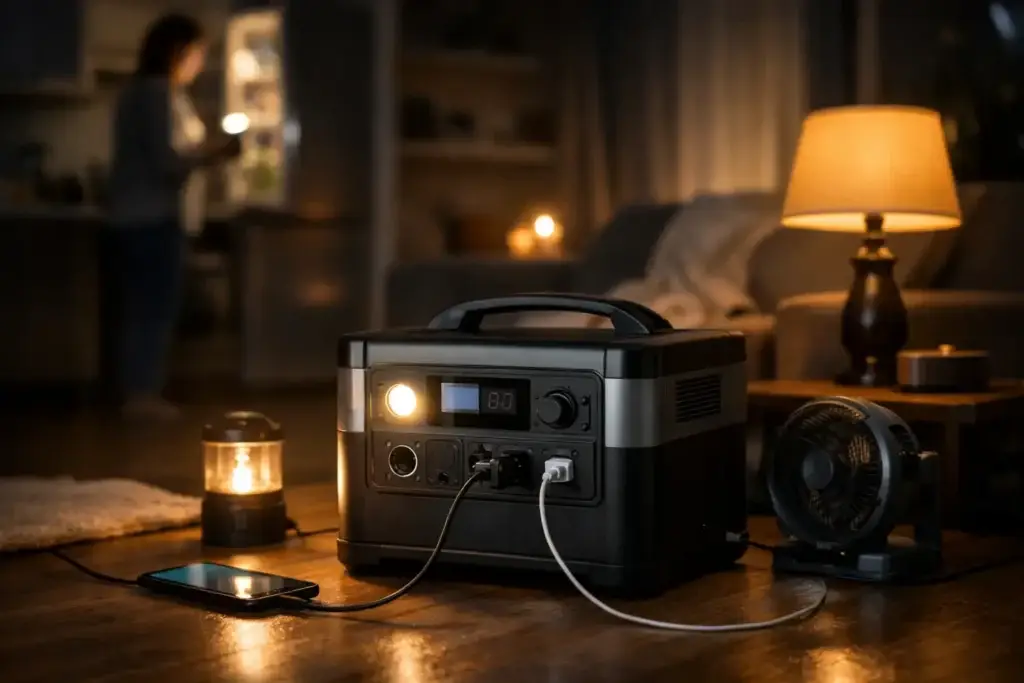
A blackout is not just an inconvenience when your phone is at 12%, the refrigerator is warming, and a family member depends on powered medical equipment. Portable power station emergency use gives your household a quiet, rechargeable source of electricity when the grid fails – but only if you choose the right capacity and prepare it before the warning alert arrives.
A power station cannot run an entire house indefinitely. It can, however, protect the essentials that matter most during the first critical hours or days: communications, light, medication storage, medical devices, weather information, and limited food preservation. Don’t wait for the storm, wildfire evacuation warning, ice event, or heatwave outage to learn what yours can actually support.
What a Portable Power Station Can Do in an Emergency
A portable power station is a large rechargeable battery with built-in outlets, USB ports, and a battery-management system. Unlike a gasoline generator, it produces no exhaust during normal operation, so it can generally be used indoors in a dry, ventilated location according to the manufacturer’s instructions. That makes it especially useful for apartments, condos, garages with the door closed, and homes where running a generator safely outside is difficult.
Its best role is targeted backup power. Use it to keep several small but essential devices running rather than trying to power every convenience appliance in the house. During an outage, priorities change fast. A television, coffee maker, space heater, or electric stove can drain a battery far faster than a phone, radio, LED light, or modem.
Here is where a power station is most valuable:
| Emergency need | Typical equipment | Why it matters | |—|—|—| | Communication | Phones, tablets, modem, emergency radio | Receive alerts, call for help, follow evacuation orders | | Light and safety | LED lamps, flashlights, headlamps | Prevent falls and keep your home usable after dark | | Medical continuity | CPAP, some oxygen concentrators, medication coolers | Supports health needs when utility power is unavailable | | Food protection | Refrigerator or freezer for limited periods | Buys time before refrigerated food becomes unsafe | | Heat and weather awareness | Small fan, weather radio, select low-watt devices | Helps manage dangerous conditions without wasting power |
A station is not a substitute for evacuation, a 72-hour kit, stored water, or a home emergency plan. If officials tell you to leave because of wildfire, flooding, or hurricane surge, take the power station if it is safe to do so, but leave without delay. Electricity does not make a dangerous structure safe.
Portable Power Station Emergency Use Starts With Capacity
The two numbers that matter most are watts and watt-hours. Watts measure how much power a device needs at a given moment. Watt-hours, usually shown as Wh, measure how much energy the station stores.
A 1,000Wh power station theoretically holds 1,000 watt-hours of energy. In real use, expect less available energy after inverter losses and battery protections. A practical planning estimate is often 80% to 85% of the stated capacity when using AC outlets. That means a 1,000Wh unit may provide roughly 800 to 850Wh of usable AC power.
To estimate runtime, multiply a device’s watts by the hours you expect to use it. A 10-watt LED light used for 10 hours needs about 100Wh. A 60-watt CPAP used for eight hours needs about 480Wh, although actual consumption varies widely with heated humidifiers, heated tubing, and pressure settings. Check the label, manual, or manufacturer specifications for every device you consider essential.
Refrigerators require extra caution in your calculations. They may average modest power over time, but their compressor can demand a much higher startup surge. A station must have enough continuous output and surge capacity to handle that startup load. Keep refrigerator and freezer doors closed as much as possible. A power station can extend safe storage time, but it is not a guarantee during a multi-day outage.
Size the station for your real emergency plan
For communications, lighting, and charging, a compact station in the 300Wh to 600Wh range may be enough for a short outage. For a CPAP, router, medication cooler, or periodic refrigerator support, many households need 1,000Wh or more. Extended outages and larger loads may justify expandable battery systems, but those systems cost more, weigh more, and still require disciplined power use.
Never buy based on a vague promise that a unit can power “everything.” Build a written load list for your household. Include the device, running watts, startup watts if applicable, expected daily use, and whether it is truly essential. This simple step prevents a costly mistake when power is already out.
Charge Before the Emergency, Then Protect the Battery
A dead power station is just a heavy box. Keep it charged according to the manufacturer’s storage guidance, especially during peak storm, wildfire, and winter-weather seasons. Set a recurring calendar reminder to inspect it every three to six months. Confirm that cables, wall chargers, vehicle chargers, adapters, and solar connectors are present and working.
Store the unit in a cool, dry area where you can access it quickly. Do not store it in a flooded basement, an uninsulated shed that experiences extreme heat, or a place blocked by heavy clutter. Keep it away from flammable materials, direct sunlight, standing water, and physical damage.
If a hurricane, flood, or plumbing failure is possible, move the station to a higher shelf or upper floor before water enters the home. Never use a damaged, soaked, swollen, smoking, or unusually hot lithium battery product. If it has been submerged, do not attempt to charge or operate it. Move away from the immediate area if safe, contact emergency services if there is fire risk, and follow the manufacturer’s disposal guidance.
Recharge Plans Matter More Than One Full Battery
For outages lasting longer than a day, recharging becomes the real problem. Wall charging is useful before and after the event, but not when the grid is down. Vehicle charging can restore some capacity, though it is usually slow and requires fuel, a safe location, and a running vehicle. Never run a vehicle in a garage or enclosed space.
Solar panels can be a strong backup option, especially after hurricanes, windstorms, and remote wildfire-related outages. But panels need daylight, clear placement, and the correct connectors. They produce far less power in heavy smoke, deep cloud cover, shade, or winter conditions. Test your solar setup before an emergency. A sealed box of unfamiliar panels will not help much on day three of an outage.
If you use solar panels, place them outdoors in sunlight and bring the cable inside only if the setup can be done without creating a trip hazard, leaving an opening vulnerable to rain, or violating safety instructions. Keep panels away from floodwater and high winds. Do not climb onto a roof during or after a storm to chase better output.
Use Power Like It Has to Last
Once an outage begins, switch to conservation mode immediately. Charge phones during the day when solar input is available. Use USB ports for phones and small electronics when possible, since converting battery power through an AC outlet can waste energy. Turn off router power overnight if internet access is not needed, and use headlamps instead of lighting whole rooms.
Avoid high-draw heat appliances. Portable electric heaters, hot plates, hair dryers, microwaves, toaster ovens, and most window air conditioners can exhaust a typical power station quickly. In winter, focus on layered clothing, blankets, safe sheltering, and your local emergency plan. In heat, use battery power for fans, communications, and cooling strategies that do not overload your available energy.
For medical equipment, prepare a separate plan now. Ask the equipment provider or clinician about battery requirements, backup options, and safe settings during an outage. Do not assume a power station will support every device or every feature for the entire night.
Make It Part of Your Family’s Outage Kit
Keep your power station with a printed load plan, charging cables, LED lights, headlamps, batteries, weather radio, first-aid supplies, and backup water. Label the cords your family will need in the dark. Teach adults and older teens how to check the remaining battery percentage and which devices are allowed to connect.
The worst day hits fast. Prepare faster. A tested portable power station will not replace utility power, but it can give your family light, information, communication, and critical breathing room when those things are hardest to replace.