
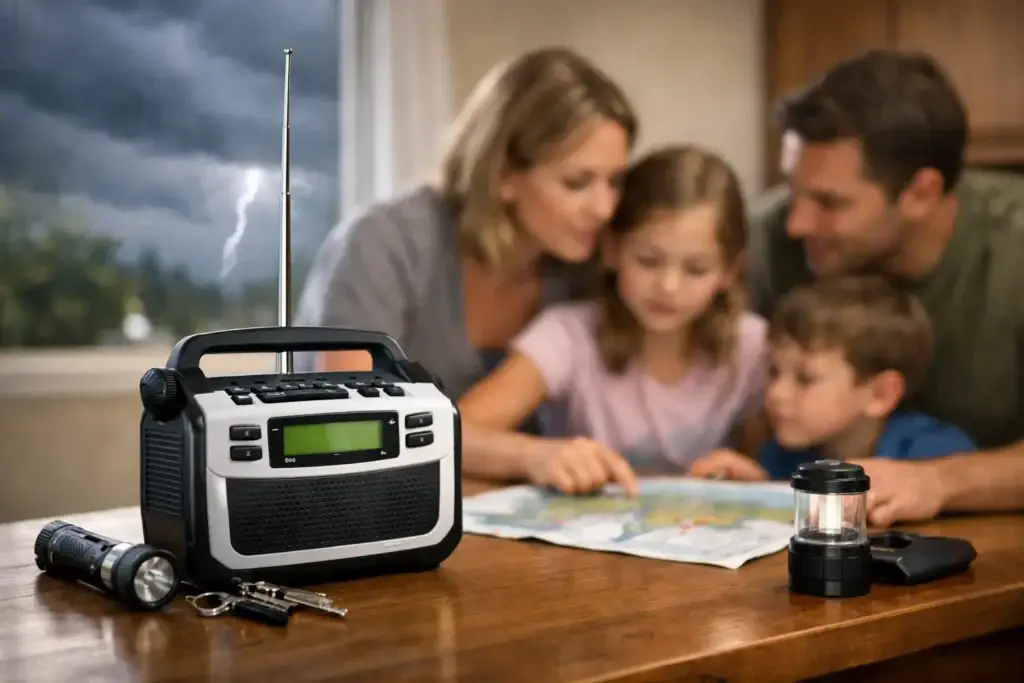
A tornado warning at 2:13 a.m. is not the time to discover your phone is silenced, the cell network is overloaded, or the power is out. NOAA weather radio recommendations matter because a dedicated alert radio can wake your household with official hazard information when the systems you use every day stop working.
A weather radio is not a replacement for evacuation planning, shelter supplies, or local emergency alerts. It is a backup built for the moment backups become necessary. Keep one where your family sleeps, program it before severe weather season, and make sure every adult in the home knows what its alarm means.
What a NOAA Weather Radio Does
NOAA Weather Radio All Hazards is a nationwide network that broadcasts continuous weather forecasts, watches, warnings, and hazard information from National Weather Service offices. Depending on your location and programming, an alert-capable radio can also receive selected non-weather emergency messages, such as civil emergencies, evacuation notices, or hazardous-material incidents.
The key benefit is independence. A dedicated radio receives an over-the-air signal rather than relying on your home internet, a mobile app, or a charged phone. During hurricanes, ice storms, wildfires, and severe thunderstorms, those everyday systems can fail at exactly the wrong time.
Do not assume every emergency radio is a NOAA weather radio. Many hand-crank radios receive AM/FM stations but cannot receive NOAA broadcasts or activate for Specific Area Message Encoding, commonly called SAME alerts. If automatic local warnings are the goal, look for both NOAA Weather Radio reception and SAME alert capability on the product specifications.
NOAA Weather Radio Recommendations: Features That Matter
The best choice depends on where you live, who is in your household, and how likely your area is to lose power. But several features are worth prioritizing over novelty features that sound useful on a product page and do little during a real emergency.
SAME county programming
SAME programming allows the radio to alert for selected counties or areas instead of sounding for every warning transmitted by the station. This matters if you live near a county line or receive broadcasts covering a large region. Without proper programming, repeated alerts for distant communities can lead to alarm fatigue. People start lowering the volume, turning the unit off, or ignoring it.
Program your home county first. If your commute, children’s school, or close family members are in neighboring counties, add those areas if the radio allows multiple codes. Check the county codes and alert settings before storm season, not while a warning is already underway.
A loud alarm and clear message display
Choose a radio with an attention signal loud enough to wake sleeping adults. A screen that displays the alert type and affected area is equally valuable. In a stressful moment, you need to know whether the alarm is for a tornado warning, flash flood warning, wildfire evacuation notice, or a lower-priority message.
Look for adjustable alert volume and a backlit display. An alert light or strobe is especially helpful for deaf or hard-of-hearing household members, people who sleep with earplugs, and homes with loud fans or window air conditioners.
Dependable backup power
A plug-in weather radio is convenient, but wall power alone is not preparedness. Select a model with battery backup and install fresh batteries immediately. Write the installation date on a small label and replace batteries on a regular schedule.
Rechargeable internal batteries can be useful, but they should not be your only backup. A long outage can drain them before the danger passes. For a stationary bedroom or kitchen radio, standard replaceable batteries are often the simplest and most dependable option. For an evacuation kit, a compact model with multiple charging methods may make more sense.
Strong reception where you actually need it
A radio with excellent reviews can still perform poorly in your house if terrain, distance from a transmitter, metal roofing, concrete walls, or nearby electronics interfere with reception. Test it in the location where it will live. Near a window or on an upper floor often works better than a basement, but do not place it somewhere you cannot hear it at night.
An external antenna connection is useful for rural homes, mountainous areas, and locations with weak signals. It adds setup work, but reliable reception is more important than a compact design when your home is far from a weather radio transmitter.
Choose the Right Radio for Your Risk
There is no single best radio for every household. Buy for the emergency you are likely to face, then build redundancy around it.
| Household situation | Best radio approach | Why it matters | | — | — | — | | Tornado or severe thunderstorm region | Plug-in SAME alert radio with battery backup and a loud alarm | Warnings can arrive overnight and leave little time to reach shelter. | | Hurricane or coastal flood zone | SAME alert radio plus a portable backup unit | Long outages and evacuation orders can make one device insufficient. | | Wildfire-prone area | Portable alert radio with replaceable batteries | Evacuation notices can change quickly, and you may need alerts away from home. | | Rural, mountain, or remote home | Radio with external antenna capability | Terrain and distance can make reception unreliable without a better antenna setup. | | Apartment or rental home | Compact alert radio with battery backup | It is easy to place near sleeping areas and take if you must evacuate. |
For most families, the strongest setup is two radios: one stationary alert radio in the main sleeping area and one portable unit in an evacuation go-bag or vehicle kit. That is not excess gear. It is protection against a dead battery, poor reception in one room, or leaving home under pressure.
Features You Can Treat as Secondary
Flashlights, USB charging ports, solar panels, hand cranks, AM/FM reception, and Bluetooth can be useful additions. They should not decide the purchase before you confirm NOAA reception, SAME alerts, alarm volume, battery backup, and signal quality.
A hand crank is a last-resort charging method, not a magic power source. Cranking long enough to maintain a phone or radio is tiring and inefficient. Solar panels are helpful in bright conditions but far less useful during heavy smoke, winter storms, prolonged rain, or when the radio is stored indoors. Treat these features as supplemental, not primary.
Likewise, a radio that charges your phone is not a substitute for a power bank or portable power station. Your emergency communications plan should include stored power, charging cables, and a written contact plan. A weather radio’s first job is delivering alerts.
Set Up Your Weather Radio Before You Need It
Buying the radio is only the first step. An unprogrammed weather radio is a box of missed warnings.
Start by installing backup batteries, extending the antenna, and placing the unit where it can receive a clear signal and wake the household. Tune to the correct NOAA frequency for your area. Program the relevant SAME county codes, then select which alert types should trigger the alarm. Follow the manufacturer’s instructions closely because menus differ by model.
Do not silence every alert category just because the first week feels noisy. Review the settings with your local hazards in mind. A household in a flash-flood area needs different priorities than one facing tornadoes, wildfires, or winter storms. If you are unsure, keep the essential warnings enabled and adjust only after you understand what each alert means.
Test reception monthly and after moving the radio, rearranging electronics, or changing batteries. If the signal drops, try another location before assuming the unit is defective. Keep the radio out of a sealed closet or emergency bin. An alert you cannot hear does not protect anyone.
Pair the Radio With a Clear Family Response
An alarm is only useful if it triggers action. Decide now where your household goes for a tornado warning, which route you use for wildfire evacuation, and where you keep shoes, flashlights, medications, pet supplies, and go-bags. Put the radio near those plans, not apart from them.
For tornado and severe thunderstorm warnings, move immediately to your designated safe room or lowest interior space away from windows. For flash flood warnings, do not drive across flooded roads. For wildfire evacuation alerts, leave early with your go-bag, documents, medications, water, and pets. A radio gives you information. Your preparation determines whether that information buys your family time.
Do not wait for the next forecast to make this purchase. Set up a NOAA weather radio this week, test it at night, and make sure the people you protect know exactly what to do when it sounds.