
A blackout does not wait until your fuel cans are full, your batteries are charged, or your family has agreed on a plan. The gas generator versus solar generator decision determines whether you can keep critical devices running safely when the grid fails. Choose based on the emergencies you face, the equipment your household must power, and how long you may be without utilities.
For many homes, the right answer is not one technology replacing the other. A solar generator can provide quiet, indoor-safe power for essentials. A gas generator can deliver the high wattage and long runtime needed for a refrigerator, well pump, furnace blower, or sump pump. But each has limits that become serious during a wildfire evacuation, hurricane, winter storm, or extended outage.
Gas Generator Versus Solar Generator: The Real Difference
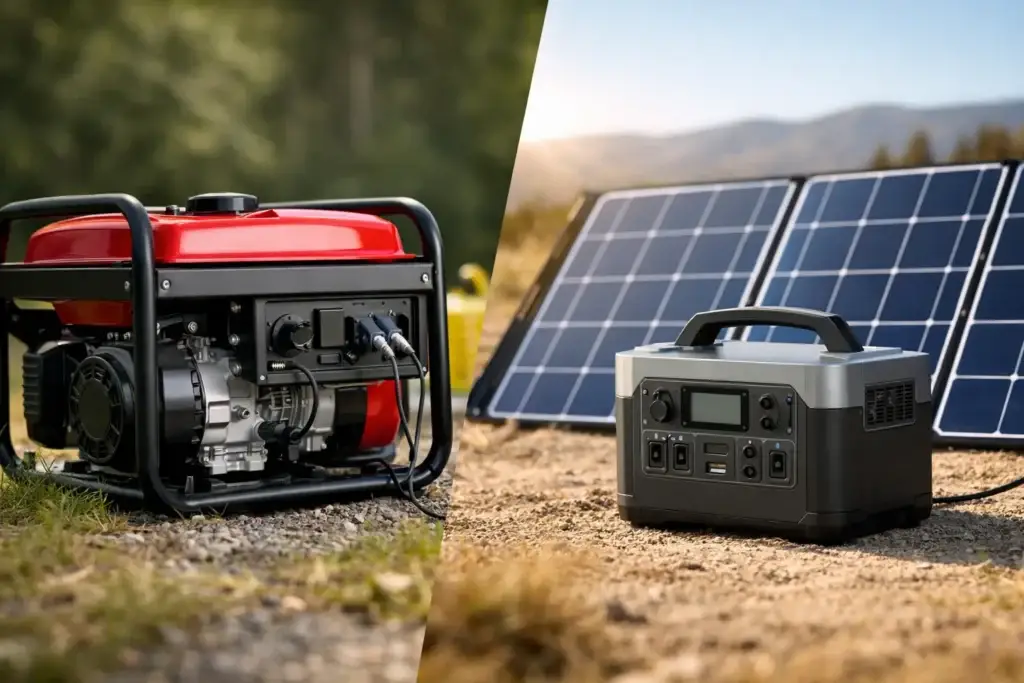
A gas generator burns gasoline, propane, or sometimes diesel to make electricity. It can produce substantial power quickly as long as you have fuel, the unit is maintained, and it is operated outdoors at a safe distance from doors, windows, vents, and attached garages.
A solar generator is a portable power station with a rechargeable battery, inverter, and charging inputs. Despite the name, it does not generate electricity on its own. It stores power from wall charging, solar panels, or sometimes a vehicle outlet, then supplies AC, USB, or DC power to your devices. It makes no exhaust and can be used indoors, but its capacity is finite and solar recharging depends on weather, daylight, panel placement, and seasonal sun.
The dangerous mistake is treating either option as automatic whole-home backup. Most portable units cannot safely run every appliance at once. Your first job is to identify what must stay on: communications, medical devices, refrigeration for food or medicine, lighting, water, heat-related equipment, and flood-control equipment.
Compare What Matters During an Emergency
| Factor | Gas generator | Solar generator | | — | — | — | | Power output | Often high enough for large appliances and motor loads | Best for electronics, lights, medical devices, and selected appliances | | Runtime | Continues with stored fuel | Limited by battery capacity and recharge conditions | | Indoor use | Never safe indoors or in enclosed spaces | Safe indoors when used as directed | | Noise | Loud, often disruptive at night | Quiet | | Fuel dependency | Needs stabilized, safely stored fuel | Needs stored charge and sunlight for solar recharge | | Bad-weather performance | Can run in poor weather if protected and safely placed | Solar input can drop sharply under clouds, smoke, snow, and shade | | Maintenance | Requires regular engine service and test runs | Lower maintenance, but battery health still matters |
Power output decides what you can save
Gas generators are usually the stronger choice when you need to start appliances with motors. Refrigerators, freezers, sump pumps, well pumps, window air conditioners, and some furnaces draw a high surge of wattage at startup. A generator must handle that surge, not just the appliance’s normal running wattage.
A solar generator can run a CPAP machine, phone chargers, a modem, LED lights, laptops, a radio, fans, and many small kitchen appliances. Larger power stations may support a refrigerator for a limited period, especially if you manage loads carefully. They are less suited to high-draw appliances such as electric space heaters, central air conditioning, electric ranges, clothes dryers, and many well pumps.
Do not buy by marketing labels alone. Check both continuous wattage and surge wattage for a gas generator. For a power station, check inverter output in watts and battery capacity in watt-hours. Output tells you what it can run at one time. Capacity tells you roughly how long it can run it.
Runtime is a fuel-planning problem
A gas generator can keep working for days, but only if your fuel supply lasts. That means calculating fuel consumption at realistic loads, rotating stored gasoline, using approved containers, and knowing where you will get more fuel if local stations are closed or out of power. During a hurricane or ice storm, fuel lines form early. Do not assume you can buy gas after the warning arrives.
Propane can be easier to store long term than gasoline and does not degrade in the same way, though you still need enough cylinders and a generator designed for it. Dual-fuel generators provide flexibility, but they do not eliminate the need to plan and test your setup.
A solar generator trades fuel storage for energy storage. If your power station has 1,000 watt-hours of usable capacity, a 10-watt phone charger can run many times, while a 1,500-watt space heater can drain it in well under an hour. Solar panels can extend runtime, but a smoky wildfire sky, winter snow cover, heavy rain, short days, or a shaded apartment balcony can reduce charging dramatically.
Safety is not optional
Carbon monoxide from portable generators kills people during outages because the threat is invisible and fast. Never run a gas generator in a garage, basement, shed, carport, enclosed porch, or near an open window. Place it outdoors, at least 20 feet from the home, with exhaust directed away from the building. Use working carbon monoxide alarms with battery backup inside your home.
Keep generators dry without enclosing them. A purpose-built open-sided generator canopy may help, but do not improvise with tarps, boxes, or tents that trap exhaust or heat. Let the engine cool before refueling. Store fuel away from living areas and ignition sources.
Solar generators remove carbon monoxide risk, which makes them especially valuable for apartment dwellers, families sheltering indoors, and anyone relying on overnight medical equipment. They still require care. Keep battery stations dry, use undamaged cables, avoid blocking ventilation, and follow manufacturer temperature limits. Do not leave a battery system in a dangerously hot vehicle or a freezing, wet outdoor area.
Choose Based on Your Household’s Risk
A solar generator is often the better first purchase if you live in an apartment or condo, need quiet indoor power, have a CPAP or other small medical device, or want a simple backup for communication and lighting. It is also useful during an evacuation because you can charge it before leaving and use it in a hotel, vehicle, shelter area, or temporary location where combustion equipment is prohibited.
A gas generator is usually the better choice for a homeowner who needs to preserve a refrigerator and freezer, run a sump pump during storm flooding, support a well pump, or keep selected heating equipment operating during a winter outage. It is most effective when paired with a safe outdoor operating location, adequate treated fuel, heavy-duty outdoor-rated extension cords, carbon monoxide alarms, and a written load plan.
For households in hurricane, tornado, wildfire, and severe winter regions, a layered system offers stronger protection. Use a solar generator for indoor essentials and overnight power. Use a properly sized gas or propane generator during daytime or when high-demand equipment must run. This approach reduces fuel use, noise, and generator run hours while protecting the equipment that cannot wait.
Build an Outage Load Plan Before You Buy
Start by writing down every device your family may need during a 72-hour outage. Include medical equipment, phones, radios, lighting, refrigerator, freezer, internet equipment, fans, sump pump, well pump, and furnace blower. Record the running watts and starting watts from each appliance label or manual.
Then separate those loads into three groups: life safety, food and water protection, and comfort. Life safety comes first. A powered medical device, communication access, and emergency lighting matter more than television, gaming systems, or a coffee maker.
Avoid backfeeding your home through a dryer outlet or other improvised connection. It can electrocute utility workers, damage equipment, and create a fire hazard. If you want selected circuits powered through your home’s electrical panel, hire a qualified electrician to install an appropriate transfer switch or interlock system. This is not a shortcut project.
Test your setup before storm season. Run the gas generator under load, inspect cords, confirm carbon monoxide alarms work, and practice refueling safely. Fully charge the power station, test the solar panels, and see how long your actual devices run. A plan that exists only on a shopping list will fail when the lights go out.
The Bottom Line for Emergency Power
Gas generators win on high-demand power and fuel-based endurance. Solar generators win on indoor safety, quiet operation, and simple access to electricity for small critical loads. Neither one makes your household prepared if you do not store fuel, maintain the equipment, understand your loads, and practice using it.
Do not wait for the first outage warning to decide what your family cannot live without. Build the power plan now, place the equipment where you can reach it in the dark, and make sure every adult in the home knows how to use it safely. The worst day hits fast. Prepare faster.