
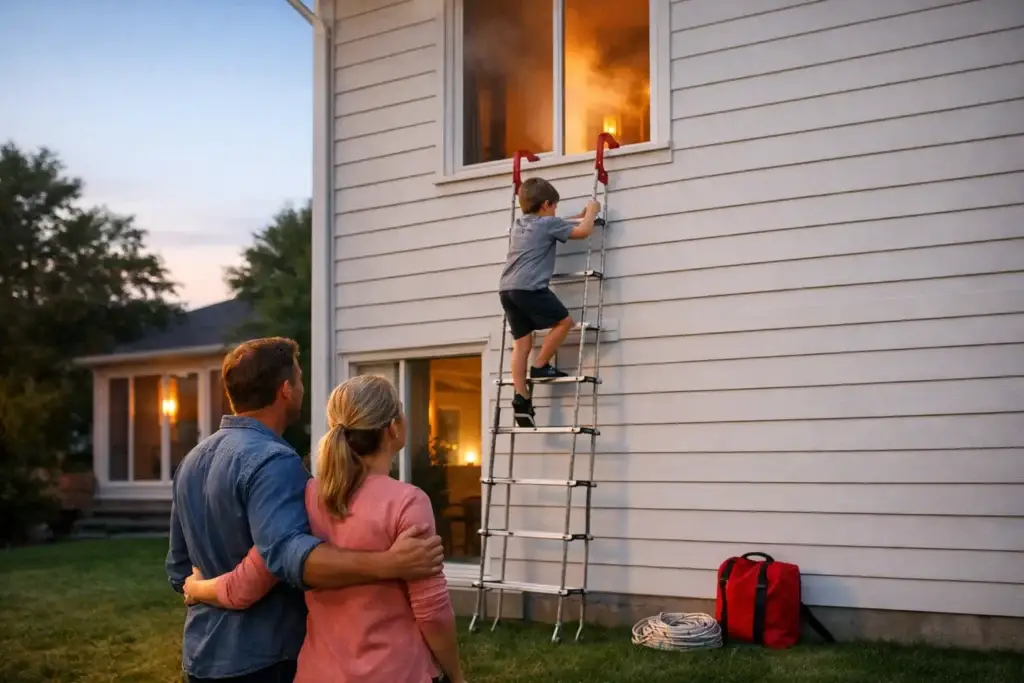
A bedroom door can become a barrier in seconds when smoke fills the hall or flames take the stairway. The best home fire escape ladders give your family another way out when the normal exit is no longer safe. They are not decoration, and they are not gear to leave boxed in a closet. A ladder only protects people when it is the right size, stored at the right window, and familiar enough to use under pressure.
For a two-story home, an escape ladder belongs in every upper-floor sleeping area that has a usable exit window. For three-story homes, you need a purpose-built ladder rated for that height, plus a plan that does not depend on one person finding and setting it up perfectly. Fire moves fast. Prepare faster.
What Makes the Best Home Fire Escape Ladders?
The right ladder is not simply the longest or least expensive option. It must match your home, your windows, and the people expected to use it. Start with the floor level. A ladder made for a second-story window is not automatically safe from a third-story window, even if it appears long enough. It needs enough length to reach the ground without leaving the bottom rungs hanging high above it.
Look for a model designed specifically as a fire escape ladder, with a clearly stated load capacity and construction meant to hold its shape while someone climbs down. Wide, rigid or semi-rigid rungs are easier to find with a foot than thin webbing steps. Non-slip rungs matter even more if a child, older adult, or someone wearing socks may need to use the ladder.
The best designs also include secure window hooks or attachment points that fit the sill you actually have. Do not assume every window works. Deep sills, sliding windows, crank-out casement windows, security bars, screens, and exterior shutters can all interfere with deployment. Measure first, then buy.
| Feature to check | Why it matters during an escape | |—|—| | Correct story-height rating | Prevents a dangerous gap between the ladder and the ground | | Rigid, slip-resistant rungs | Makes footing more predictable in darkness and panic | | Adequate weight capacity | Allows for the heaviest expected user and real-world clothing or gear | | Window-compatible hooks | Keeps the ladder attached securely to your specific sill | | Fast deployment | Reduces the chance of tangles, snags, and wasted seconds | | Independent safety testing | Adds confidence that the product was evaluated beyond marketing claims |
Avoid bargain ladders with vague specifications, no stated load limit, or thin rungs that twist underfoot. Saving a few dollars is not a win if the ladder is difficult to deploy when your family needs it most.
Permanent vs. Portable Escape Ladders
Most households choose between a portable ladder kept near a window and a permanently installed escape ladder mounted outside the home. Both can be effective, but they solve different problems.
Portable ladders work for many second-story bedrooms
Portable ladders are compact, less expensive, and practical for renters because they do not require exterior installation. They usually hook over a window sill and unroll down the side of the home. A well-designed two-story portable ladder can be an excellent choice for a child’s room, guest room, or upstairs hallway window.
The trade-off is deployment. Someone must open the window, remove the ladder from storage, hook it correctly, release it, and climb down. That process is manageable when practiced, but it is harder in smoke, darkness, or panic. Some portable models are one-time-use by design after being deployed. Know that before you practice with the actual unit.
Permanent ladders reduce setup time
A permanently mounted exterior ladder is already in place. That can make it a stronger option for a third-story bedroom, a home with frequent guests, or households where a child or older adult may struggle with a portable ladder. The trade-off is cost, exterior appearance, installation work, and possible local code or landlord restrictions.
Permanent ladders still require planning. Make sure the path beneath the window remains clear year-round. A ladder that ends behind a locked gate, thorny landscaping, stacked patio furniture, or an enclosed pool area may not lead to safety.
Match the Ladder to Your Window and Exterior
Before ordering, inspect every possible escape window from inside and outside. The window should open easily without a key, special tool, or adult strength. Remove or modify any security device that could trap someone inside, while keeping home security in mind. Window screens should be easy to remove, but do not count on a screen as protection against a fall.
Outside, check for power lines, fuel tanks, propane equipment, fences, roof overhangs, basement stairwells, and dense shrubs. Never plan to descend a ladder into hazards you have not addressed. If the chosen window opens over a deck or porch roof, decide whether the ladder can safely reach the ground from that surface or whether a different exit window makes more sense.
A window escape route is a secondary exit, not a reason to use a blocked route. If smoke or flames are coming from that window, stay out of it. Close the bedroom door to slow fire and smoke, use another available exit, and call 911 once you are outside. If you cannot safely leave, close the door, block smoke around gaps if possible, signal from a window, and tell emergency dispatch where you are.
Choose for the People Who Must Use It
A ladder that works for a fit adult may fail the rest of the household. Children can be afraid of height, struggle to swing through a window, or have trouble moving from the sill onto the first rung. Older adults may have balance, grip, or mobility limitations that make a ladder unrealistic. Pets add another hard truth: carrying one down a ladder may be unsafe or impossible.
Build your plan around people, not wishful thinking. Assign adults to children and decide which adult uses which route. If a child’s room has an escape ladder, practice the window-to-ladder transition with direct supervision. Do not send a child down a ladder alone during a drill unless they can truly do it safely and confidently.
For bedrooms occupied by people who cannot use an escape ladder, focus on a protected shelter-in-place plan as well. That means a working smoke alarm, a closed bedroom door at night, a phone within reach when possible, and a clear plan to signal firefighters from the window. An escape ladder is valuable equipment, but it cannot replace a realistic household fire plan.
Store It Where the Fire Will Not Block It
Keep a portable escape ladder in the room where it will be used, beside or directly below its designated window. Do not store it in a hall closet, garage, attic, or basement. Those locations may be inaccessible once smoke reaches the hallway or the stairs are blocked.
Make the storage location obvious and free of furniture. A heavy dresser under the window can make opening the window and reaching the sill harder. Curtains, blinds, and decorative items should not interfere. If the ladder comes in a case, keep the instructions with it, but do not let reading instructions be the first step anyone takes during a real fire.
Check the ladder twice a year when you test smoke alarms and replace batteries if your alarms use replaceable batteries. Inspect hooks, straps, rungs, stitching, and the storage bag for damage, moisture, or missing parts. Replace a ladder that has been deployed in an emergency or damaged during practice unless the manufacturer specifically confirms it is reusable and safe to reset.
Practice the Escape Plan Before You Need It
A fire drill should be short, serious, and repeated. Sound the alarm, have everyone use their primary exit if it is safe, and meet at a fixed location away from the home. Then separately practice the escape-ladder route in daylight with calm supervision. The goal is not to create fear. The goal is to remove uncertainty.
Teach every family member three rules: get out, stay out, and call 911 from outside. Do not go back for phones, schoolwork, medication, or pets. If one person is missing, tell firefighters immediately. Going back inside turns one emergency into two.
Buy the ladder that fits your home, place it at the window tonight, and practice the first movements this week. When the stairway is gone and the hallway is dark, preparation is what gives your family another chance to get out alive.